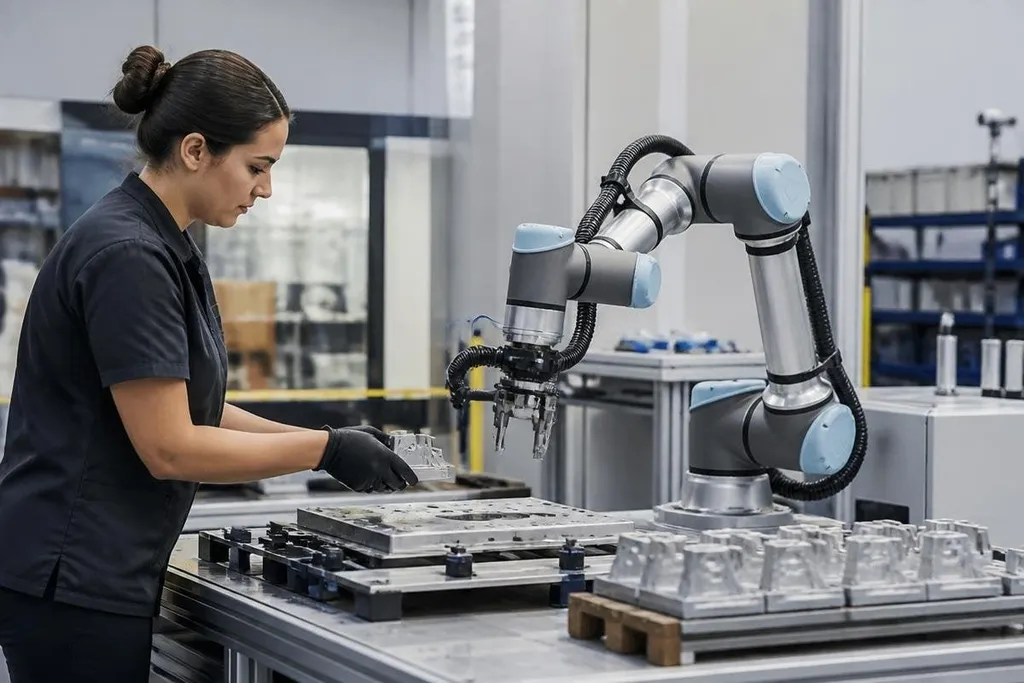
A collaborative robot, or cobot, works near people instead of sitting behind a fence. The global race is moving from arm design to the harder question: can these systems do useful work safely, day after day?
- Cobots need safe contact limits, simple setup, and steady task results.
- A fast arm still fails if workers spend hours teaching every new part.
- Buyers should ask for task data, safety details, and support terms.
What makes a cobot useful
A cobot has sensors that watch its motion and the force at its joints. Those systems can slow or stop the arm when a person enters its path or when the arm meets an unexpected object.
That safety layer matters because a cobot may share a work area with an operator. The arm still needs a risk check for the full task, including the tool, the part, the table, and the space around the cell.
A safe robot arm does not make every application safe by itself.
The work also decides what “better” means. A packing task may need repeatable position and steady speed. A machine-tending task may need reach, grip force, and enough protection from heat or sharp parts. A small assembly job may care more about easy teaching than top speed.
The race is moving into software
Most cobot arms can repeat a programmed motion. The harder work starts when the part shifts, the bin empties, or a worker changes the process. Software must help the arm sense that change and recover without creating a new hazard.
That is why programming time matters as much as payload. A technician may teach a path by guiding the arm, using a tablet, or writing code. Each method can work, but the useful measure is the time needed to move from the first setup to a stable production task.
The same test applies to vision. A camera can find a part, but the system still needs to decide where to grip it and what to do when the part is blocked. Buyers should ask for the failure rate under the actual lighting, part mix, and cycle time they expect.
For cobot buyers, Robot24.com robotics coverage can tie a maker’s claim to the named arm, task, test site, and date. That record gives you a clear starting point before reach, payload, and force limits decide which jobs the cell can handle.
Hardware limits still shape the job
A cobot cannot ignore physics. Payload falls as reach increases, and a larger tool can reduce the weight left for the part. Speed can also be limited by the safety settings and the distance between the arm and nearby people.
Cycle time needs a full count. Include the arm’s motion, gripper action, vision check, part handoff, and any stop caused by a person entering the area. A quoted arm speed says little if the complete task takes twice as long.
Support can decide the result after installation. The buyer needs spare parts, software updates, training, and a clear answer when the arm stops during a shift. Those details rarely appear in a short product demo, yet they affect the cost of keeping the cell running.
A buyer’s check before a pilot
Use this list before comparing models or signing a trial agreement:
- Name the task: Write down the part, tool, reach, payload, cycle time, and shift length.
- Watch the failure case: Ask the supplier to show recovery after a misplaced, blocked, or missing part.
- Check the safety file: Confirm the risk assessment process, stop behavior, speed limits, and required guarding.
- Count setup hours: Record who will program the cell and how long a new task takes to teach.
- Price the support: Ask about training, service visits, software fees, spare parts, and response times.
- Set the pass mark: Choose the cycle time and fault rate that make the pilot useful before it starts.
A pilot should measure completed work, operator time, stops, rejected parts, and recovery steps. That record gives you something stronger than a smooth demo because it shows where the system earns its place and where a human still has to step in.
I'd skip any cobot sale that offers arm speed without task results. The next useful comparison will be simple: how many good parts the system completes per shift, and how much attention it needs from the person beside it.